
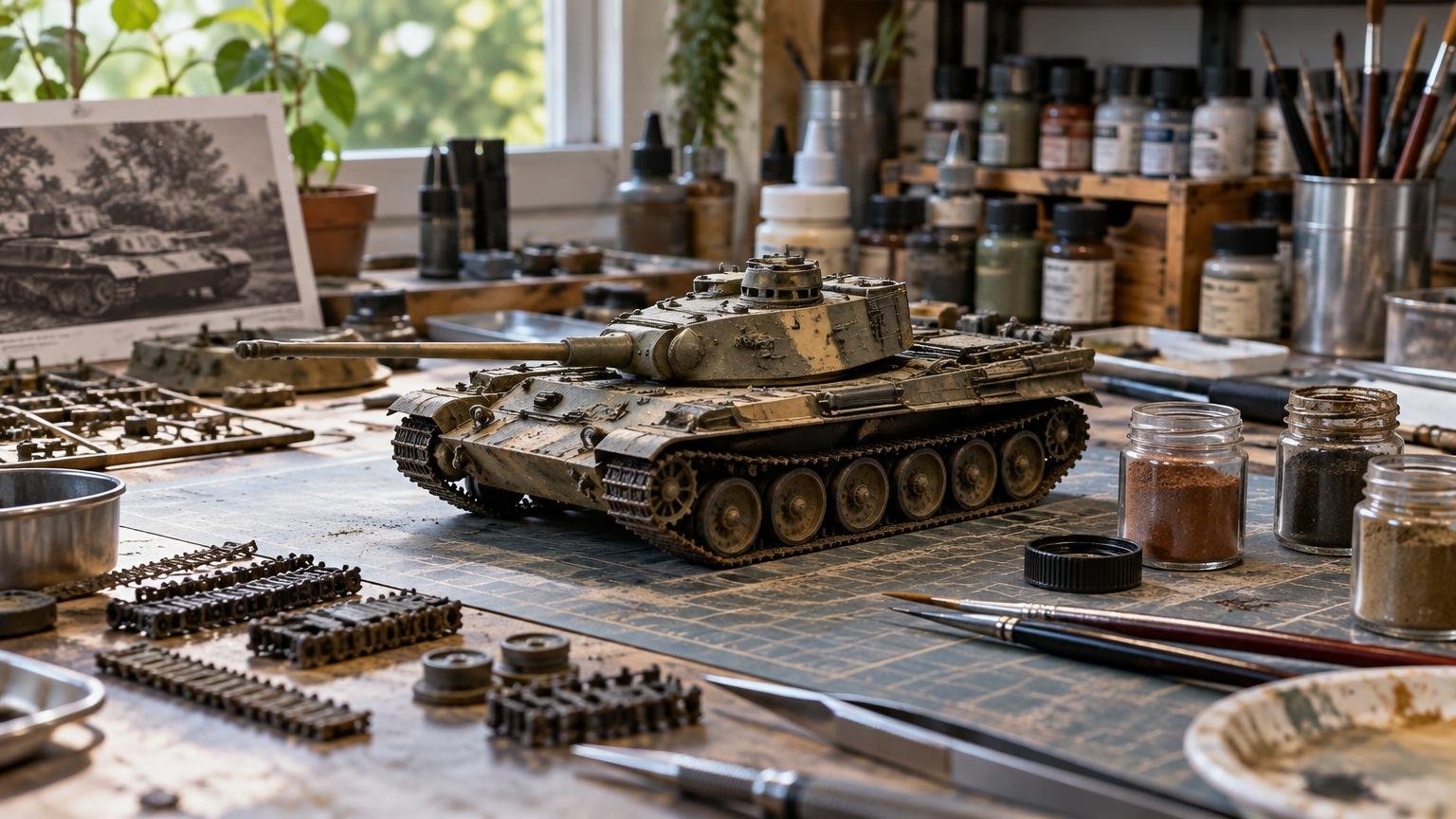
Scale Modeling: Armor, Painting, Weathering and Dioramas
Make deliberate finishing choices that add convincing realism without burying your model.
Scale Modeling: Armor, Painting, Weathering and Dioramas
AusfWerks is a scale-modeling publication for builders who care about how a miniature surface tells the story of a real machine. Armor and military subjects sit at the center, with room for aircraft, dioramas, and the finishing problems they share. The aim is not to add every available effect. It is to decide which changes in color, sheen, texture, and wear will make a model more convincing at its scale.
Good finishing begins before the first stain or pigment touches the model. The vehicle’s material, service environment, maintenance, age, and intended display condition all affect the answer. A factory-fresh machine, an operational vehicle, and an abandoned wreck should not receive interchangeable treatment. AusfWerks covers those distinctions so that paint and weathering support a readable condition rather than becoming a collection of unrelated techniques.
Painting coverage focuses on choices that shape everything applied afterward: surface preparation, primer, base color, tonal variation, brush and airbrush control, clear coats, and the sheen needed for the next step. It also considers how color changes when reduced to miniature scale. Strong contrast may help a small subject remain legible, but exaggerated modulation can pull attention away from construction, markings, and the recognizable character of the vehicle.
Weathering is treated as an exercise in placement and restraint. Dust settles differently from wet mud. Polished contact surfaces do not behave like oxidized steel, painted armor, rubber, canvas, or wood. Spills, chips, streaks, and accumulated dirt need a plausible source and direction. Coverage therefore asks where an effect belongs, how strong it should be, and whether it clarifies the model’s story or simply makes every surface equally busy.
Small details often decide whether a finish holds together. Tracks need abrasion related to their construction and contact points. Road wheels, tools, exhausts, grilles, cables, hatches, and stowage require distinct materials without turning into isolated demonstrations. Decals need a smooth foundation and controlled setting process, while photo-etched parts earn their place only when their finer thickness or sharper detail remains visible on the completed model.
Diorama coverage extends the same discipline beyond the vehicle. Groundwork, structures, vegetation, figures, and scattered objects should agree on scale, season, location, and condition. Printed components can provide repeatable forms; scratch-built scenery can introduce variation where repetition looks artificial. Historical references can establish what was present, while composition and selective emphasis remain artistic decisions. The useful result respects both evidence and the practical need to make a small scene readable.
Latest from AusfWerks
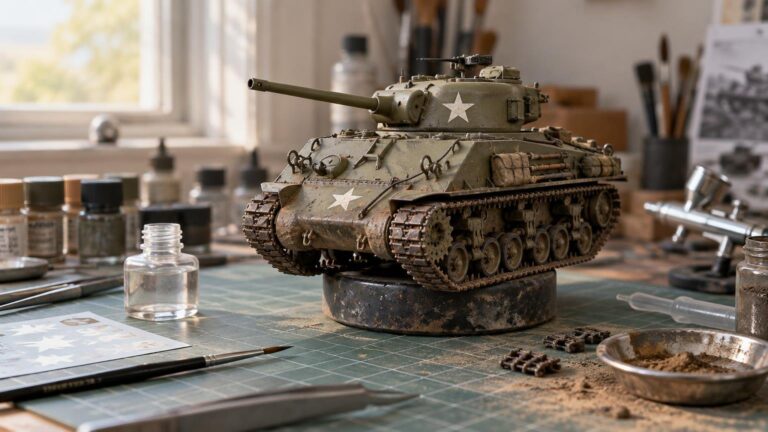
In What Order Should You Paint, Decal, Weather, and Varnish a Tank Model?
A practical tank-model finishing sequence covering cured paint, decals, protective clear coats, washes, chipping, pigments and final sheen.
Read more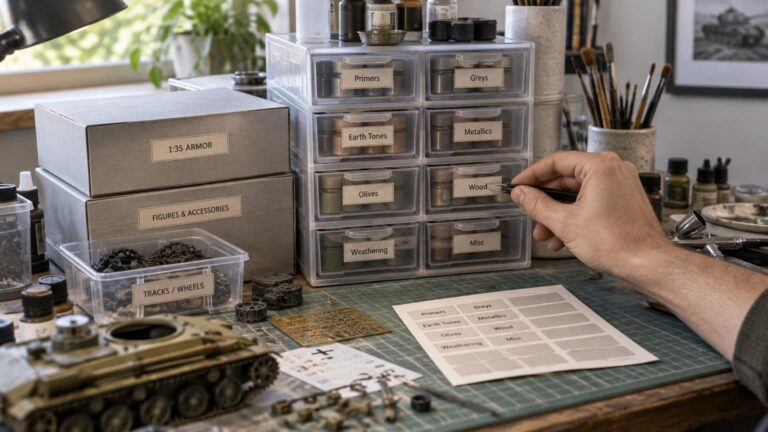
Ordering Custom Labels for Model-Kit Boxes and Paint Storage
Choose between individual die-cut labels and mixed sticker sheets, design readable artwork, and proof labels for kit boxes, paint drawers, parts bins, and display-base storage.
Read more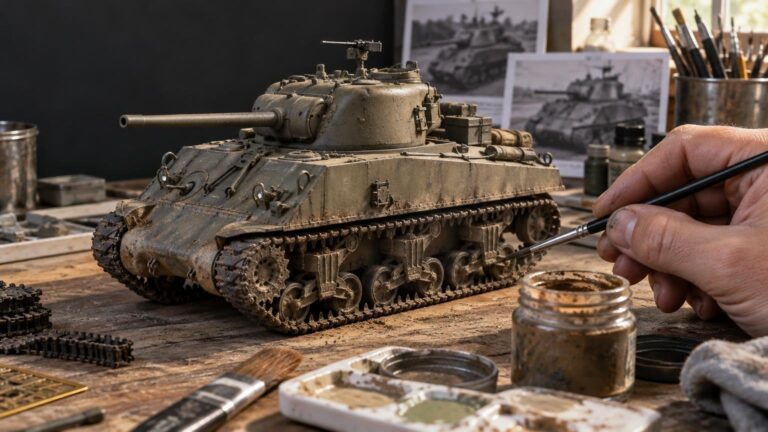
How Much Weathering Makes Sense for a Historically Based Model?
A practical framework for choosing historically plausible dust, mud, wear, stains and corrosion without letting effects overwhelm the model.
Read more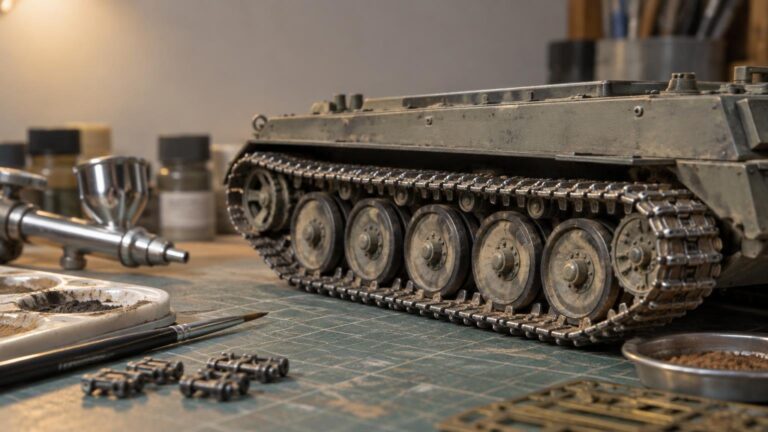
How to Paint Realistic Steel Tracks on an Armor Model
Build convincing armor tracks with a dark steel foundation, selective abrasion, and terrain effects matched to the vehicle’s construction and condition.
Read more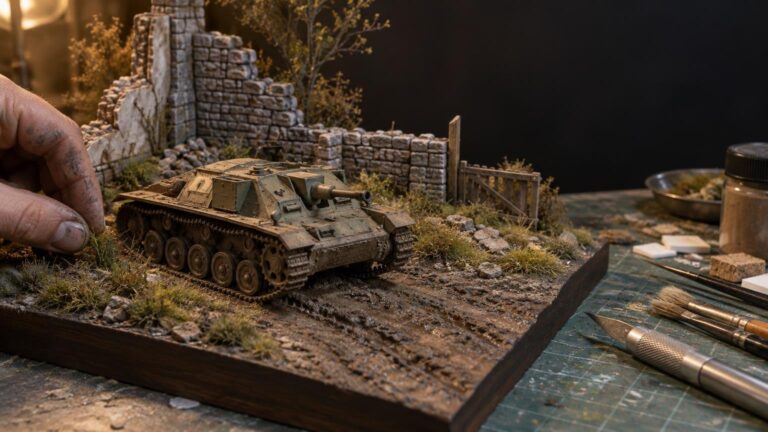
Buying Printed Terrain vs Scratch-Building Diorama Scenery
Printed components excel at repeatable structures, while scratch-building gives groundwork its natural variation. Here is how to choose—or combine—the two.
Read more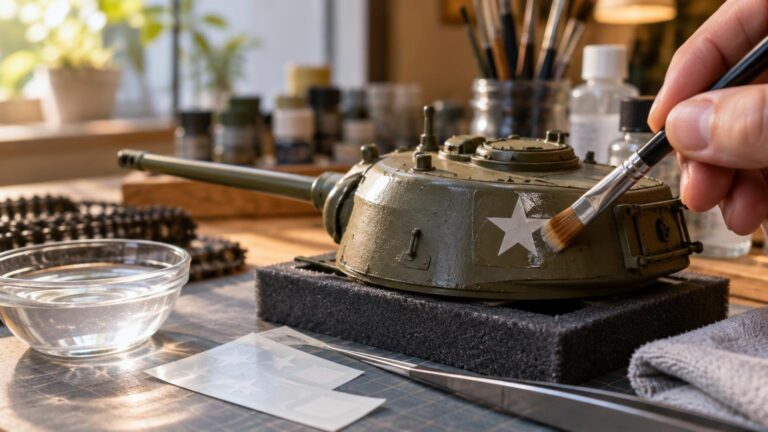
How to Apply Model Decals Without Silvering
Prevent decal silvering with a smooth decal bed, careful moisture removal, controlled setting solutions, and a final clear coat that unifies the finish.
Read moreBuild the Finish Around a Clear Story
A convincing model does not require the maximum number of products, colors, or stages. It requires a hierarchy. Decide what the viewer should notice first, then let secondary effects support that point. On an armor model, the focal area might be a turret, a distinctive marking, exposed track wear, or the relationship between the vehicle and its groundwork. When every panel receives equal emphasis, the model loses the visual logic that makes detail meaningful.
Scale and viewing distance should change the method. A subtle variation that works on a large model may disappear on a smaller one, while a broad chip or heavy streak can become oversized immediately. AusfWerks examines techniques in their relevant scale and kit context instead of presenting one recipe as universal. The question is always practical: what must be adjusted so the effect reads clearly without making the miniature resemble a full-size surface sampled and reduced without judgment?
Historical grounding supplies boundaries rather than a compulsory level of grime. Instructions and product documentation help establish application requirements. Museum and period references can clarify construction, markings, materials, and likely patterns of use, though restored vehicles need careful interpretation. Artistic choices still matter because a model must communicate under display lighting and from ordinary viewing distances. The publication distinguishes documented features from plausible interpretation so readers can choose knowingly rather than confuse dramatic presentation with historical certainty.
The most useful workflow is usually cumulative and reversible for as long as possible. Establish the underlying color and material, protect completed work when the next medium requires it, and add effects in small steps. Pause before repeating the same treatment across another panel. Differences between horizontal and vertical surfaces, exposed and sheltered areas, or crew-contact and untouched zones often create more realism than stronger color alone. Restraint is not an absence of weathering; it is control over where attention goes.
Use AusfWerks as a practical bench-side guide to painting, weathering, armor details, decals, photo-etched parts, diorama materials, and historically grounded presentation. Start with the task that currently blocks the build, identify the condition that changes the answer, and choose the smallest effective intervention. A smooth decal bed, a better track color, corrected sheen, or more selective dirt placement may do more than another complete layer of effects. The finish should reveal the model, not bury it.
Frequently Asked Questions
What subjects does AusfWerks cover?
AusfWerks covers scale modeling with armor and military subjects at the center, including aircraft, painting, weathering, detail work, decals, photo-etched parts, and dioramas.
How does AusfWerks approach weathering?
Weathering is treated as a deliberate choice based on scale, material, use, environment, and condition, with realism favored over covering every surface in effects.
Does AusfWerks separate historical evidence from artistic interpretation?
Yes. Historical and technical references establish useful boundaries, while presentation choices are identified as interpretation when they go beyond documented evidence.